
Parenting a Child with Profound Autism

Written by Satu Väänänen
Where do you even begin?
Maybe with the fact that life changes so much that at some point you stop noticing that it is somehow different from everyone else’s. Things other families simply do become things that have to be carefully planned and analysed in advance every single time, like some kind of quantum physics hypothesis. A trip to the store, a car ride, a doctor’s appointment or a school day is broken down almost minute by minute: visual schedules are made, you think about who is going along, what if there is a wait, what if they get hungry, what if the noise is too much, what if you have to leave halfway through, what if there is even the smallest change to the plan.

When There Are No Words
When your child does not speak, over the years you learn to watch everything else. Are they eating normally, sleeping longer or less than usual, is their movement different, are they biting their wrist more, are they restless or somehow unusually quiet, is their breathing faster, are their vocalisations different, their expression, their gaze, their movement… The list is endless.
Sometimes you know immediately that something is wrong. Sometimes everyone spends days, even weeks, trying to work out the reason. Sometimes you later realise you were completely wrong. At times home feels like a rehabilitation centre where you are practically standing at the door like a bouncer, letting in the occupational therapist, speech therapist, rehabilitation counsellor and disability services workers.
Being unable to speak is also heartbreakingly sad. When I think about what it would feel like for me, I imagine an entire personality and an entire world trapped inside my own head. If your child is completely non-speaking, you never hear the word mum or dad. Not as a first word, and not later either.
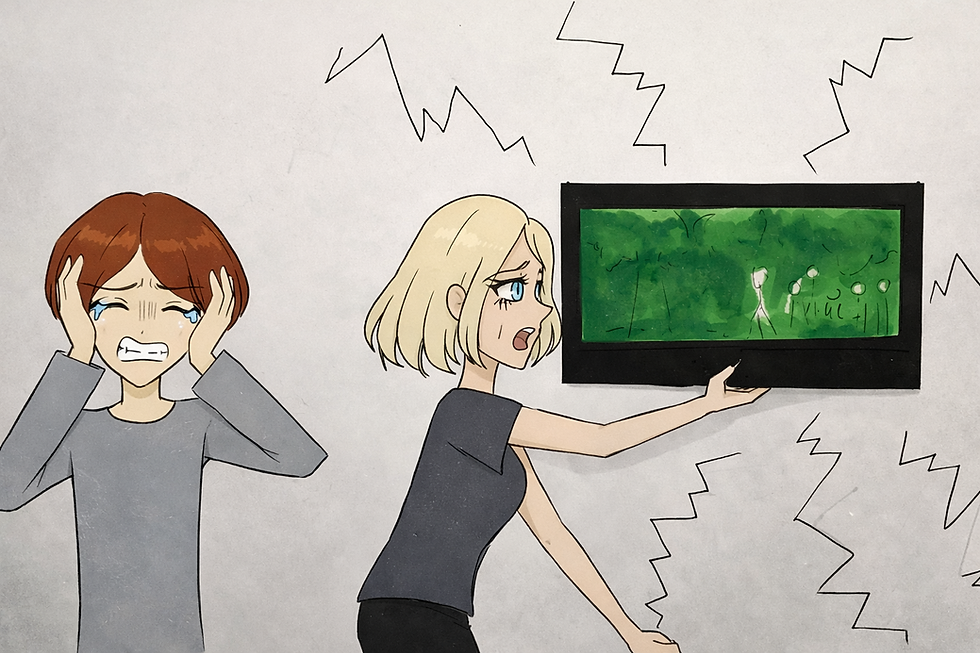
Then There Is the System
Then there is the system. Over the years you have to explain the same things to new people again and again: what they understand, how they express themselves, what their behaviour might mean, what helps and what makes things worse.
Sometimes someone understands quickly, and then you realise how much easier life could be if everyone understood. Sometimes it feels as though a parent first has to prove the whole person before their needs are believed.
A parent gets to be a therapist, rehabilitation worker, lawyer, police officer, support worker, teacher, social services advocate, doctor, nurse and parent all at the same time.
Things that should belong to the child as support often have to be fought for by the parents and justified through endless forms and appeals. This is what exhausts you the most, not everyday life itself.
When Your Own Life Starts to Build Itself Around Everything Else
Over the years, your own life starts to build itself around all of this. People suddenly disappear from your life, but the most important ones stay.
You realise that you cannot really talk naturally about your everyday life with anyone except other parents who have lived the same thing, people who understand and with whom you can talk about your normal daily life in a way where the other person also sees it as normal, not as something pitiful to feel sorry for.
Parenting a child with profound autism creates strange survival strategies that somehow keep carrying you forward. You do not even think about the fact that you are constantly on standby.
Your phone is always with you so you can be reached. Plans are arranged around everything else. You think about which parent can go, which one stays, who can pick them up if the day has to end early.
So many things get cancelled so many times that eventually you stop even planning some of them.
Often one parent has to stay out of working life altogether, or build their work around being at home, so they can receive the child if things do not work out in another environment that day, stay home with them, or support the people around them when a more difficult period hits after a good one.
But There Is Much More to Life Than That
And still, there is a lot of laughter. You see the good in small things and in small steps forward. You love enormously, and you see the beautiful person underneath all the complexity.
Profound autism does not make life nothing but tragedy, and in the end everyday life is ordinary in our own way.
There are our own things, familiar expressions, humour and things whose meaning only the people closest to them understand.
It is our kind of everyday life. Different.

What Happens When We Are No Longer Here?
Perhaps the heaviest thought for a parent comes with the future.
As your child grows into an adult, you cannot simply think, they will manage. At some point you have to think about where they will live, who will know them best, who will notice if something hurts, who will know how to interpret them when their parents are not there and are growing older.
And eventually you have to think about the day when the parents are no longer alive.
This is probably the greatest weight a parent carries in their heart.
How do you make these changes early enough? How do you know when the right time is? Who will take care of them when I am no longer here?
Not a Heroic Story
Parenting a child with profound autism is not some heroic story. It is a different kind of story, filled with enormous love and, at the same time, comedy, drama, a touch of horror, thriller and fantasy.
Satu Väänänen is a psychiatric nurse, neuropsychiatric coach and specialist in profound autism, with more than 15 years of first-hand experience of everyday life with a profoundly autistic person. She provides training for professionals on profound autism in Finland and internationally, and publishes guides and practical tools in Finnish and English at lainatturauha.com/en.
Lainattu Rauha® · Borrowed Peace


Comments